Blog for Journey to Galaxies

  • Welcome to Galaxy Explorer!

    Welcome! This website is my personal journey into the world of astronomy and space exploration. Ever since I was young, I’ve been captivated by the mysteries of the cosmos—the twinkling stars, distant galaxies, and the endless possibilities that lie beyond our sky.

    Through this blog, I hope to share not only what I’ve learned but also the excitement of discovery with fellow galaxy explorers. Together, we’ll venture across the galaxies, unravel the mysteries of the stars, and celebrate the beauty of the universe, one post at a time.

    So join me on this adventure—because the universe is vast, and the journey has only just begun. 🌌

  • The Great Divide: 67 or 72?

    Yes, there’s a 67 in here. No, it’s not the 67 that most people would (unfortunately) think about. The two numbers I’ve written here correspond to the values of the Hubble constant, a cosmological parameter that defines the present expansion rate of the universe.

    The units for this constant are a little bit strange, namely km s-1 Mpc-1 (which if you simplify, becomes s-1, or Hertz (frequency)?!). Essentially, what it means is that if you place a stationary object 1 Mpc away (roughly 3.16 million light years away), that object will appear to be receding away from you at a speed equal to the Hubble constant solely due to the expansion of the universe.

    The problem that scientists are trying to solve is that there is a large difference between the measurements for this value based on the cosmic microwave background and based on galaxies and supernovae. This is called the Hubble tension, and it’s a very big deal within the cosmology community as the acceptance of one value over another could mean redefining our model of the universe.

    Observations of the early universe, mainly from the cosmic microwave background, measured by missions like Planck and DESI, suggest a slower expansion rate of around 67 km s-1 Mpc-1. Meanwhile, measurements of the late universe, using supernovae, Cepheid stars, and other distance indicators, consistently give a faster rate of about 72 km s-1 Mpc-1. This 2.2-sigma deviation has persisted despite improved measurements, suggesting that either there are unknown systematic errors in one or both methods, or our current cosmological model (ΛCDM) might be missing new physics, such as exotic dark energy behavior or additional relativistic particles in the early universe.

    If you’ve been reading my other posts, my series on DESI DR1 aims to help contribute to the existing studies of the Hubble constant by computing the value at high redshifts from the latest publicly available data.

  • DESI DR1 – Progress!

    For those who are relatively new to reading my work, here’s a little bit of background information in the event you haven’t seen my previous posts on this topic.

    This year, I’ve decided to take on the challenge of wrangling with Dark Energy Spectroscopic Instrument data again. This time, instead of the Early Data Release, which contains pruned and polished data, I’m using the full Data Release 1 which was released in April of 2025, just a month before I presented my EDR results at the National Junior Science and Humanities Symposium. The main difference between the EDR and DR1 is the amount of data available, where I now have nearly 10 times as much data to work with.

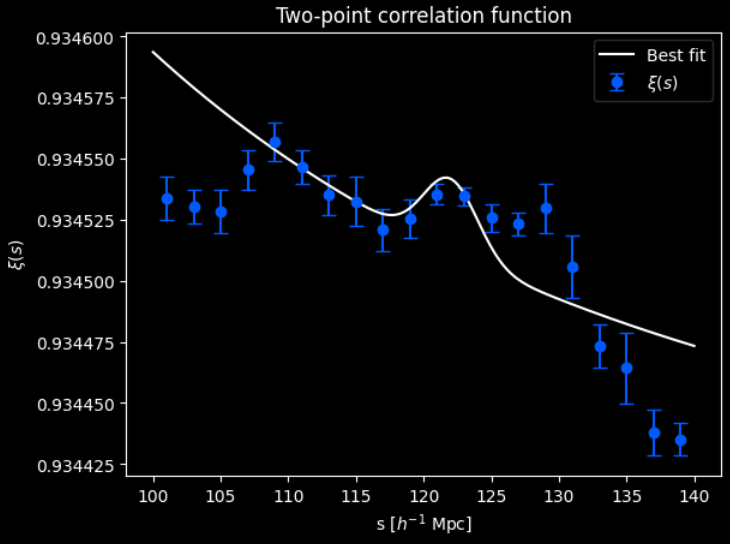
    I’ve finally got around to getting the correlation figured out, and I’ve run a best fit model for the data I have currently. The peak is a little higher than expected, but this is probably because of redshift distortions that I haven’t corrected for yet.

    The result is definitely promising, and I think this was a pretty nice bonus Christmas present. I’m looking to compute a covariance matrix for my results and finally finishing my project soon.

  • What are Baryon Acoustic Oscillations?

    Most people would imagine that the universe is silent, but is it really that quiet out there? For starters, the current density of the universe is too low to allow for the effective transmission of sound waves, but peering back to the early days of the universe suggests otherwise.

    Baryon acoustic oscillations (BAOs) are essentially sound waves frozen in time. Until about 380,000 years after the Big Bang, the universe was a hot, dense plasma of photons, electrons, and protons (collectively called baryons). In this plasma, tiny over-dense regions created pressure waves, much like sound waves in air, propagating outward at nearly half the speed of light. These waves traveled until the universe cooled enough for photons to decouple from matter, creating the cosmic microwave background (CMB) and leaving behind a subtle imprint in the distribution of matter: regions slightly more likely to host galaxies.

    Today, these ancient ripples show up as a faint but measurable preference for galaxies to be separated by roughly 500 million light-years. By mapping these distances across vast galaxy surveys, astronomers can use BAOs as a “standard ruler” to measure cosmic expansion. This makes them a powerful tool for understanding the mysterious dark energy driving the universe’s accelerated expansion. Essentially, BAOs allow us to look back in time, connecting the physics of the infant universe to the large-scale patterns we see in the cosmos today.

  • DESI DR1 – Roadblocks

    This year, I’ve decided to take on the challenge of wrangling with Dark Energy Spectroscopic Instrument data again. This time, instead of the Early Data Release, which contains pruned and polished data, I’m using the full Data Release 1 which was released in April of 2025, just a month before I presented my EDR results at the National Junior Science and Humanities Symposium.

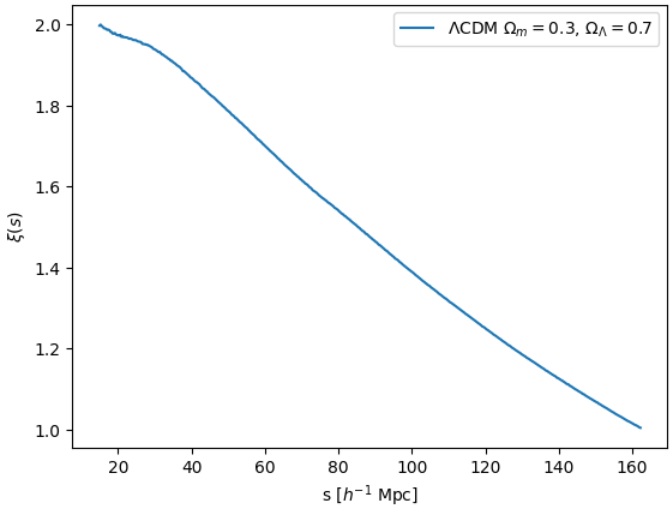
    The main difference between the EDR and DR1 is the amount of data available, where I now have nearly 10 times as much data to work with. However, this data is unfiltered and thus many of the datapoints contain missing values or are otherwise unusable. I wasn’t aware of that initially, resulting in whatever this disappointment is:

    Normally, one would expect a bump around the 100-110 h-1 Mpc range, but as you can see above, nothing is there. I realized that the data I was using was unfiltered and thus thousands of bad datapoints were causing problems with the correlation function estimator. I plan on doing a re-run with data that does not have missing values.

  • DESI DR1 – An Independent Study

    This year, I’ve decided to take on the challenge of wrangling with Dark Energy Spectroscopic Instrument data again. This time, instead of the Early Data Release, which contains pruned and polished data, I’m using the full Data Release 1 which was released in April of 2025, just a month before I presented my EDR results at the National Junior Science and Humanities Symposium.

    The main difference between the EDR and DR1 is the amount of data available, where I now have nearly 10 times as much data to work with.

    I decided to continue researching baryon acoustic oscillations as I felt that there was a lot of knowledge to be gained, even though I spent a full year researching the topic last year. While my project did end up taking me to both NJSHS and VJAS, I know there’s still a lot of room for improvement, such as using less approximations with my mock datasets as well as implementing new methodologies to increase overall accuracy. I’ll try my best to keep updating my progress as I continue my work this year.

  • Close Calls in Orbit Highlight the Growing Threat of Space Debris

    In December 2025, the Chinese Kinetica -1  spacecraft passed within roughly 200 meters of SpaceX’s Starlink-6079 satellite in low Earth orbit (LEO), narrowly avoiding a collision at orbital speeds (over 17,000 mph). SpaceX noted that a lack of shared trajectory data and cross-operator coordination contributed to the risk, underscoring the urgent need for better space-traffic management as orbital congestion grows.

    Just weeks earlier, a suspected impact from tiny orbital debris struck the Shenzhou-20 return capsule, causing cracks in its window and delaying the planned November return of three Chinese taikonauts from the Tiangong space station. The crew ultimately returned safely aboard a different spacecraft, but the incident highlighted how even millimeter-scale fragments — too small to track — can threaten human spaceflight and capsule integrity.

    These near-accidents are more than isolated scares; they serve as warning signs of Kessler syndrome, where collisions generate cascading debris that trigger further impacts, potentially rendering large regions of low Earth orbit unusable for decades. Such an outcome would jeopardize weather forecasting, communications, Earth observation, scientific research, and future human spaceflight, dramatized in the 2013 film Gravity.

    Crucially, this is not only an engineering challenge but a policy failure. Space is a shared global commons, yet traffic coordination, debris mitigation, and accountability remain largely voluntary and fragmented. To safeguard access to LEO, the international community must move toward binding space-traffic management frameworks, mandatory data sharing, enforceable end-of-life disposal rules, and sustained investment in debris-removal technologies.

    Without collective action and responsible governance, Earth’s orbit risks becoming a graveyard of our own making. With cooperation, transparency, and forward-looking policy, however, we can preserve space as a sustainable environment for exploration, science, and generations to come.

  • C/2025 N1 and C/2025 K1

    What are they, you would be wondering.

    If I told you that C/2025 N1 is the designation of the third interstellar comet ever detected by humans, you would know it has the other widely known name 3I/ATLAS. Its orbit is hyperbolic, meaning that it’s moving too fast to be gravitationally bound to the Sun and that the trajectory traces back beyond the solar system. It passed inside the orbit of Mars on its path through the inner solar system, and its closest approach to Earth will be around December 19, 2025 — about 170 million miles away.

    Because it didn’t form around our Sun, its composition, structure, and behavior offer a window into how comets, and perhaps planetary systems, elsewhere in the galaxy evolve.

    The less-known C/2025 K1 is a more modest comet — a native of our own solar system’s distant Oort Cloud. Astronomers around the world watched in real time as it dramatically broke up into 3 or 4 pieces after its close approach to the Sun between November 11 and 13, 2025 after surviving perihelion, its closest encounter with the sun.

    It’s hard not to feel a sense of cosmic humility when you think about it. In a single year, we’ve witnessed two remarkable cosmic events: one object, voyaging across the galaxy, unbound to the Sun’s gravity; another, a quiet resident of our solar system finally succumbing to solar forces after a lonely journey from the Oort Cloud.

    It makes me wonder — out there, beyond our telescopes, how many more icy rocks from distant stars are drifting, awaiting their turn to pay a visit to our neighborhood? ☄

  • Book Review: Alien Earths

    When I first peered through my backyard telescope at the faint smudge of the Andromeda Galaxy, I wasn’t just looking outward. Instead, I was searching inward, wondering whether somewhere in that sea of stars, another child might be gazing back, asking the same question: Are we alone? Lisa Kaltenegger’s Alien Earths: The New Science of Planet Hunting and the Search for Life Beyond Earth doesn’t just answer that question, it reframes it, transforming cosmic wonder into a rigorous, hopeful, and deeply human scientific quest.

    Kaltenegger, a leading astrophysicist and director of the Carl Sagan Institute, writes with the clarity of a teacher and the passion of a pioneer. She guides readers through the evolution of exoplanet science – from the first wobbles detected in distant stars to the atmospheric fingerprints of potentially habitable worlds. What makes Alien Earths exceptional is not just its scientific depth, but its narrative arc: it’s the story of how humanity learned to see planets we cannot visit, using light bent by gravity and spectra split by prisms, all to answer an ancient question with modern tools.

    Reading this book felt like a conversation with a mentor who understands both equations and emotions. Kaltenegger doesn’t shy away from uncertainty; she embraces it as the engine of discovery. When she describes how the James Webb Space Telescope might one day detect bio-signatures – oxygen, methane, or even industrial pollutants – in an exoplanet’s atmosphere, she doesn’t promise aliens. Instead, she offers something more profound: a methodology for hope grounded in evidence.

    This resonated deeply with my own journey. Like Kaltenegger, I began with awe – a six-year-old mesmerized by black holes at the Air and Space Museum – and gradually learned that wonder must be paired with work. In my high school astronomy club, I’ve tried to emulate her spirit: not just showing Saturn’s rings, but explaining how we know they’re there. Similarly, while analyzing public datasets on detecting Baryon Acoustic Oscillations at high redshift range, I’ve wrestled with noise, calibration, and false results —experiences Kaltenegger vividly recounts from the front lines of planet hunting. Her book validated that frustration is part of the process; every ambiguous signal is a step toward clarity.

    One of Alien Earths’ most compelling insights is its emphasis on Earth as a template – and a warning. Kaltenegger shows how studying Earth’s own atmospheric evolution helps us interpret alien skies, but also reminds us that habitability isn’t guaranteed. A planet in the “Goldilocks zone” may still be barren, just as Earth itself has teetered on the edge of catastrophe. This duality struck me as I stood on a golf course last spring, watching a thunderstorm roll in: even our stable-seeming world is dynamic, fragile, and rare. Kaltenegger’s vision isn’t just about finding Earth 2.0—it’s about understanding what makes Earth 1.0 worth protecting.

    Alien Earths is more than a science book; it’s a call to participate. Kaltenegger writes not as a distant authority, but as an explorer inviting us aboard. For students like me – tutoring in math, coding simulations, or organizing telescope nights – her message is empowering: the search for life beyond Earth belongs to all of us. It requires coders, educators, engineers, and dreamers.

    In the end, this book is a perfect reflection of why I keep looking up. The night sky is a laboratory, a testing ground, and a community. Lisa Kaltenegger’s Alien Earths is an essential guide to that cosmos, reminding us that the search for other worlds is, ultimately, a profound journey to understand our own. It is a compelling, hopeful, and brilliantly accessible work that will leave you gazing at the stars with a renewed sense of purpose and wonder.
  • Ripples of Space Time

    Ten years ago — September 14, 2015 — something remarkable happened: for the first time, humans detected gravitational waves. That moment didn’t just confirm a prediction made by Einstein more than a century earlier; it gave us a new sense. Astronomy could no longer rely on light alone. We gained ears for the cosmos.

    I was in second grade when it happened. I don’t remember the day itself — only a vague memory of my dad telling me the story months later, wide-eyed over the kitchen table. The idea stuck with me: people use telescopes to see the universe, and now, with instruments like LIGO, we can also listen to it. That small, almost-childlike astonishment grew into something deeper as I got older.

    Learning about gravitational waves opened doors to other discoveries and concepts that reshape how we think about the cosmos. I learned about gravitational radiation from merging black holes and neutron stars, and about the cosmic patterns encoded in Baryon Acoustic Oscillations that act like a ruler for the expanding universe. Each concept felt like learning a new sense or tool — a way to probe corners of reality that were previously hidden.

    The decade since that detection has been a lesson in humility and wonder. Astronomy isn’t just about better telescopes or bigger observatories; it’s about inventing entirely new languages for the universe to speak. We’ve moved from watching to listening, and with every new “note” we hear, the universe becomes a little richer, stranger, and more inviting.

    Looking back, I like to think that my childhood fascination—sparked by a late-night kitchen conversation—was the first small step in a lifelong curiosity. Ten years on, that curiosity is still here: excited by what we can see, and even more excited by what we can now hear.

  • Book Review: What If?

    Have you read What If?  by Randall Munroe, the creator of the famous xkcd comics?

    This book is unlike any traditional science text. Munroe takes the strangest, funniest, and sometimes downright ridiculous questions—like “What would happen if you tried to hit a baseball pitched at 90% the speed of light?”—and answers them with real science, math, and a healthy dose of humor. What makes it special is that you don’t need to be a professional physicist or mathematician to enjoy it. The explanations are written in an approachable way, with clever stick-figure illustrations that keep things light while still making you think.

    Whether you’re a nerd who is deeply serious about STEM, or someone who leans more toward the arts and humanities, What If?  is the kind of book that works for everyone. It’s perfect to pick up during a study break, when you’re bored, or when you just want to see how science can be used to explore the absurd. It’s entertaining, thought-provoking, and strangely inspiring—it reminds us that curiosity, no matter how odd the question, can lead to fascinating insights about the universe.

    I’ve had this book since 6th grade, and it’s still one of my favorites on the bookshelf. No matter how many times I read it, I always stumble upon something new—whether it’s a quirky detail in the illustrations, a fresh perspective in the explanations that I didn’t catch before, or even a “what if” question that I come up with myself, like what would it be like to play golf on Mars?