Category: Uncategorized

  • The Great Divide: 67 or 72?

    Yes, there’s a 67 in here. No, it’s not the 67 that most people would (unfortunately) think about. The two numbers I’ve written here correspond to the values of the Hubble constant, a cosmological parameter that defines the present expansion rate of the universe.

    The units for this constant are a little bit strange, namely km s-1 Mpc-1 (which if you simplify, becomes s-1, or Hertz (frequency)?!). Essentially, what it means is that if you place a stationary object 1 Mpc away (roughly 3.16 million light years away), that object will appear to be receding away from you at a speed equal to the Hubble constant solely due to the expansion of the universe.

    The problem that scientists are trying to solve is that there is a large difference between the measurements for this value based on the cosmic microwave background and based on galaxies and supernovae. This is called the Hubble tension, and it’s a very big deal within the cosmology community as the acceptance of one value over another could mean redefining our model of the universe.

    Observations of the early universe, mainly from the cosmic microwave background, measured by missions like Planck and DESI, suggest a slower expansion rate of around 67 km s-1 Mpc-1. Meanwhile, measurements of the late universe, using supernovae, Cepheid stars, and other distance indicators, consistently give a faster rate of about 72 km s-1 Mpc-1. This 2.2-sigma deviation has persisted despite improved measurements, suggesting that either there are unknown systematic errors in one or both methods, or our current cosmological model (ΛCDM) might be missing new physics, such as exotic dark energy behavior or additional relativistic particles in the early universe.

    If you’ve been reading my other posts, my series on DESI DR1 aims to help contribute to the existing studies of the Hubble constant by computing the value at high redshifts from the latest publicly available data.
  • DESI DR1 – Progress!

    For those who are relatively new to reading my work, here’s a little bit of background information in the event you haven’t seen my previous posts on this topic.

    This year, I’ve decided to take on the challenge of wrangling with Dark Energy Spectroscopic Instrument data again. This time, instead of the Early Data Release, which contains pruned and polished data, I’m using the full Data Release 1 which was released in April of 2025, just a month before I presented my EDR results at the National Junior Science and Humanities Symposium. The main difference between the EDR and DR1 is the amount of data available, where I now have nearly 10 times as much data to work with.

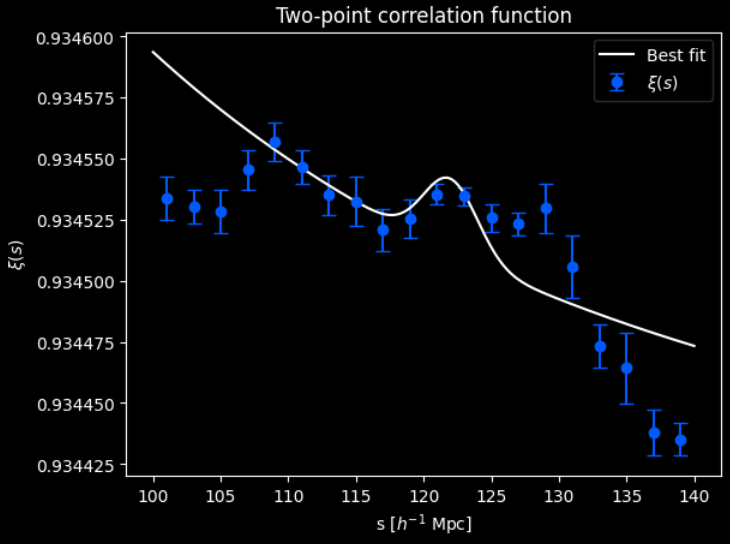
    I’ve finally got around to getting the correlation figured out, and I’ve run a best fit model for the data I have currently. The peak is a little higher than expected, but this is probably because of redshift distortions that I haven’t corrected for yet.

    The result is definitely promising, and I think this was a pretty nice bonus Christmas present. I’m looking to compute a covariance matrix for my results and finally finishing my project soon.

  • DESI DR1 – An Independent Study

    This year, I’ve decided to take on the challenge of wrangling with Dark Energy Spectroscopic Instrument data again. This time, instead of the Early Data Release, which contains pruned and polished data, I’m using the full Data Release 1 which was released in April of 2025, just a month before I presented my EDR results at the National Junior Science and Humanities Symposium.

    The main difference between the EDR and DR1 is the amount of data available, where I now have nearly 10 times as much data to work with.

    I decided to continue researching baryon acoustic oscillations as I felt that there was a lot of knowledge to be gained, even though I spent a full year researching the topic last year. While my project did end up taking me to both NJSHS and VJAS, I know there’s still a lot of room for improvement, such as using less approximations with my mock datasets as well as implementing new methodologies to increase overall accuracy. I’ll try my best to keep updating my progress as I continue my work this year.